
컨텐츠 영역
- Date 2026.06.10
- Update 2026.06.10
- Division Division of Allergy and Respiratory Disease Research
- Tel 043-719-8655
New Insight into Why Lungs Harden: Immune Mechanisms that Worsen Pulmonary Fibrosis
∙ Discovery of the ATF3 gene’ role modulating the progression of pulmonary fibrosis.
∙ Identification of a potential therapeutic target to develop innovative treatment strategies against pulmonary fibrosis.
Osong, 28 April 2026 ━ The Korea National Institute of Health (KNIH) uncovered the new function of the ATF3* gene, which modulates abnormal immune responses in the progression of Idiopathic Pulmonary Fibrosis (IPF), publishing an article in an international journal on 5th February.
* ATF3 (Activating Transcription Factor 3): A transcriptional regulator that is activated when cells encounter inflammation or various stress stimuli, regulating in-vivo metabolic processes, immune responses, and so on.
※ The article is published online in the top-ranked international journal for Allergy/Immunology, “Clinical Science (IF:7.7).” (Reference: Loss of ATF3 exacerbates pulmonary fibrosis via enhanced neutrophil recruitment and profibrotic macrophage polarization. Clinical Science. (2026) 140(2):179-199 [First Author; Se-hyang Hong, Corresponding Author; Won-ho Kim, Jung-yeon Hong])
IPF is a severe and refractory lung disease of unknown cause, hardening lung tissues and progressively declining respiratory function. As the poor prognostic disease advances, patients experience severe shortness of breath that interferes with everyday life activities, mostly leading to death within a few years after diagnosis.
At current, only two therapeutics* are used for IPF, not fully curing the disease but merely slowing the progression. Therefore, KNIH has conducted the research investigating mechanism of pulmonary fibrosis and key regulators of the progression.
* Pirfenidone and Nintedanib
The researchers induced pulmonary fibrosis using ATF3 knockout mouse model to determine how the ATF3 influences immune mechanisms and fibrosis in the lung.
As the result of study, ATF3 deficiency significantly exacerbated lung function. Compared to wild-type (WT) mice and ATF3 knockout (KO) ones exhibited a 20-25% reduction in lung capacity (WT showed a 15-20% reduction), increased pulmonary elastance, and decreased pulmonary compliance, indicating progressive lung stiffening. These findings suggest that ATF3 deficiency can accelerate the fibrotic process and worsen lung function.
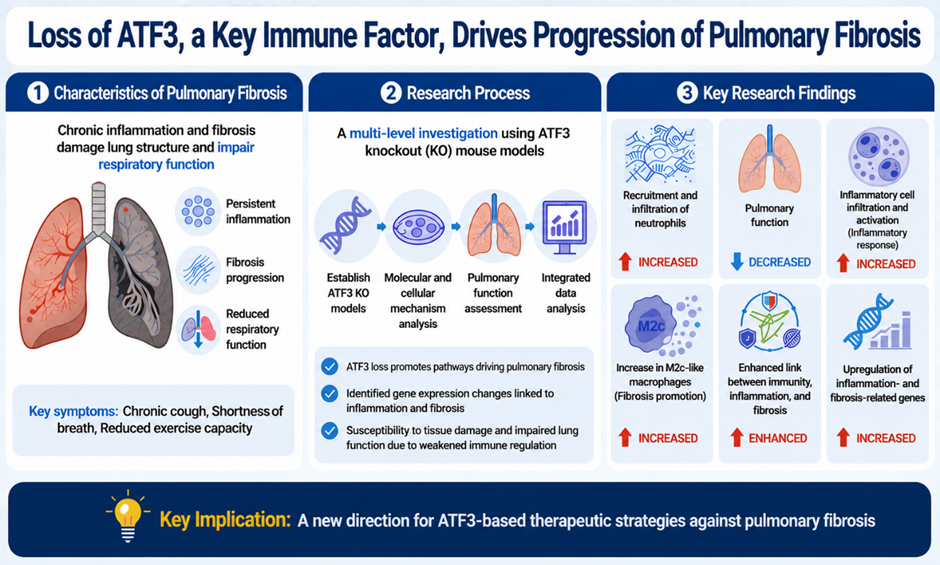
Moreover, ATF3 deficiency markedly amplified inflammatory responses in lung tissue and changed the ratio of immune cells: neutrophils (early response cells against inflammation) increased approximately 10-fold and M2c macrophages (fibrosis-prompting cells) increased approximately 6.5-fold. Along that, fibrosis-related genes were up-regulated, leading to intensified inflammation and tissue damages.
Transcriptomic analysis demonstrated that ATF3-deficient mice show a 1.5-fold increase in inflammation- and fibrosis-associated gene e-x-p-r-e-s-s-i-o-n and robust activation of immune-related pathways. These data underscore that the ATF3 plays a paramount role to modulate immune response and control the fibrotic process.
The research team stated “we have discovered a novel molecular mechanism to simultaneously regulate inflammatory immune-cell activity and tissue fibrosis during the progression of pulmonary fibrosis. Meaningfully, we confirm the ATF3’s crucial and proactive role to suppress inflammation and alleviate fibrosis.”
KNIH Director General for Chronic Disease Convergence Research, Won-ho Kim highlighted, “Pulmonary fibrosis is a challenging and intractable chronic lung disease. So, the new therapeutic strategies are obviously needed,” adding, “we strive to continue identifying mechanisms of chronic respiratory diseases and translate these outcomes into clinical and practical treatments for patients.”