What is Hansen’s disease?
- It is a chronic infectious disease caused by the bacterium Mycobacterium leprae, which primarily affects the skin and peripheral nerves, resulting in immunological disorders.
- As of now, it has not been successfully cultured artificially, and the multiplication rate of the bacterium is very slow, with an incubation period known to be 5 to 30 years.
Status of Hansen’s disease
- Since 2008, single-digit new cases have been reported, and in 2024, a total of 5 new cases of Hansen’s disease were reported, all of whom were foreigners.
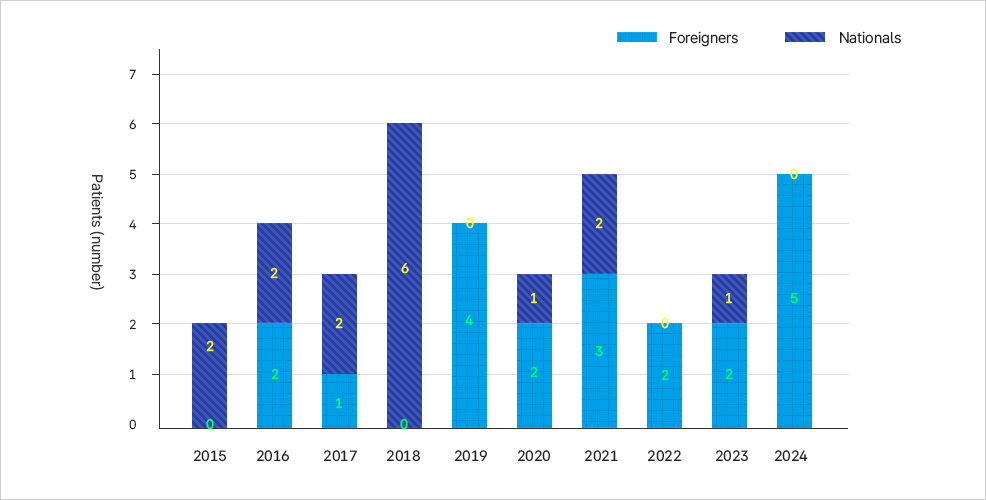
이 그래프는 2015년부터 2024년까지 국내 보고된 한센병 환자 수를 내국인과 외국인으로 구분하여 보여준다. - 2015년: 내국인 2명, 외국인 0명 - 2016년: 내국인 2명, 외국인 2명 - 2017년: 내국인 2명, 외국인 1명 - 2018년: 내국인 6명, 외국인 0명 - 2019년: 내국인 0명, 외국인 4명 - 2020년: 내국인 1명, 외국인 2명 - 2021년: 내국인 2명, 외국인 3명 - 2022년: 내국인 0명, 외국인 2명 - 2023년:
Symptoms of Hansen’s disease
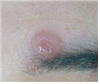
- The main symptoms of Hansen's disease include skin lesions with decreased sensation, nodules, papules, spots, and rashes, as well as peripheral nerve thickening or sensory nerve paralysis and pain.
Arm
Face
Leg
Philtrum
Eyebrow
Back
Diagnosis of Hansen’s disease
- Clinical symptoms of Hansen’s disease must be present along with the following test results.
- Confirmation of Mycobacterium leprae by molecular biological testing methods
- Confirmation of Hansen’s disease granuloma findings in the tissue biopsy
- Confirmation of acid-fast bacilli in the smear test of the lesion (acid-fast staining)
Treatment of Hansen’s disease
- It is a curable disease through multidrug therapy (dapsone, rifampicin, clofazimine) that prevents transmission to others.