컨텐츠 영역
- Date 2025.01.10
- Update 2025.01.20
- Division Division of Epidemiological Data Analysis
- Tel 02-3384-1555
[A summarized unofficial version of the press release]
KDCA Expands Access to Infectious Disease Big Data for the Private Sector: Promoting Research Through Data-Sharing and Collaboration
- KDCA offers customized data to the public via the Infectious Diseases Portal (dportal.kdca.go.kr).
- Data will be made available to the public through various channels, including a statistics dashboard and Open API.
Osong, 10th January 2025 – The Korea Disease Control and Prevention Agency (KDCA) has taken a significant step in enhancing data accessibility for the private sector, enabling researchers to access requested data through its Infectious Disease Big Data Platform.
Launched in June 2024, this platform supports the KDCA and local governments in disease control and prevention by providing automated statistical data and customized analyses.
Since 2022, the KDCA, in collaboration with the National Health Insurance Service (K-COV-N), has made COVID-19 data publicly available. Furthermore, the agency has developed its own open data system, offering datasets on 64 infectious diseases under comprehensive routine surveillance, excluding tuberculosis and acquired immunodeficiency syndrome (AIDS). These datasets include:
• 17 Class 1 infectious diseases
• 20 Class 2 infectious diseases
• 27 Class 3 infectious diseases
Researchers can apply for data access via the Infectious Disease Portal (dportal.kdca.go.kr) by submitting required documents, including research proposals and applications for protected data access. Each application undergoes careful review, and data is provided after pseudonymization to ensure privacy protection.
|
|
|
|
Infographic on the Infectious Disease Big Data Platform |
Infectious Disease Portal (Notice) |
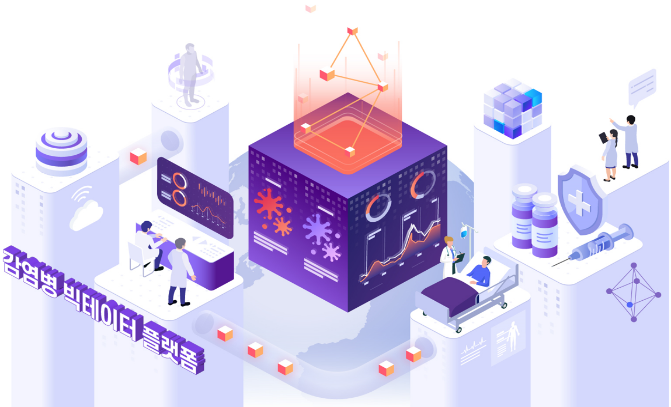

To improve user experience, the KDCA has introduced a dashboard featuring visualized data, such as bar and line graphs. Previously, infectious disease statistics were only available in tabular formats, which often made information challenging to interpret. Open API* is also available on the Public Data Portal (data.go.kr).
* Open API: An interface allowing developers to access and use publicly available data and services.
This year, the KDCA has begun sharing data to support three key projects:
l Development of a drug supply and demand risk prediction model, in collaboration with the Ministry of Food and Drug Safety.
l Korea-Clinical Data Utilization Network for Research Excellence (K-CURE), in partnership with the National Cancer Center.
l Analysis of gaps in treatment of COVID-19 patients, led by the Gangwon State Center for Infectious Diseases.
|
Name of Institute |
Purpose |
Data provided |
|
Ministry of Food and Drug Safety, Chungbuk National University |
Development of a drug supply and demand risk prediction model |
Reported infectious disease cases |
|
National Cancer Center |
Establishment of cancer public library database |
COVID-19 outbreak data |
|
Gangwon State Center for Infectious Diseases |
Analysis of gaps in treatment of COVID19 patients |
COVID-19 outbreak data |
“We expect that providing access to infectious disease data will foster groundbreaking research across diverse fields and inform public policy that benefits the public,” said Dr. Youngmee Jee, Commissioner of the KDCA. “We remain committed to supporting researchers as we continuously expand data accessibility through this platform.”
* For detailed information, please refer to the press release written in the Korean language in the file attached below.