Providing Scientific Evidence for Quarantine Policies
Overview
- Strengthening ongoing infectious disease response capabilities after the end of the COVID-19 pandemic and enhancing the infectious disease prediction system to prepare for future pandemics
About the task
- Predicting the scale of ongoing infectious diseases such as COVID-19 and influenza to provide a basis for quarantine response
- Identifying the latest technological trends from various fields such as AI, statistics, and mathematics, and promoting the development and enhancement of prediction methodologies based on this
- Promoting the establishment of a collaboration system with private prediction experts to minimize prediction uncertainty caused by changes in various factors such as population behavior and virus characteristics
Infectious Disease Prediction Analysis Cases
-
<2024 Summer COVID-19 ARI Prediction>
-
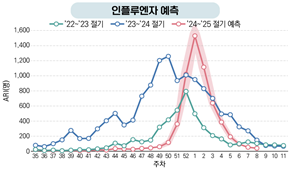
<24-25 Season Winter Influenza ARI Prediction>
◾ Progress - Systematic organization of the main forecasting models used during the COVID-19 period and develop the Korea Disease Control and Prevention Agency’s own model - Providing a basis for decision-making in quarantine policies through predictions of the COVID-19 outbreak in summer 2024 and influenza outbreaks in winter - Promoting the establishment of a collaboration system with private prediction experts - Promoting research on the development of spatial and temporal simulations in preparation for pandemics ◾ Direction of work promotion - Performing short-term predictions and medium-to-long-term outlooks through collaboration with private experts during infectious disease outbreaks, and quantitatively analyzing the effectiveness of quarantine measures to support decision-making based on scientific evidence - Supporting the establishment of effective quarantine strategies from the early stages of a pandemic by building sophisticated simulation models and predicting infection transmission patterns and the effectiveness of quarantine measures across regions in advance to prepare for future pandemics
Progress
- Systematic organization of the main forecasting models used during the COVID-19 period and develop the Korea Disease Control and Prevention Agency’s own model
- Providing a basis for decision-making in quarantine policies through predictions of the COVID-19 outbreak in summer 2024 and influenza outbreaks in winter
- Promoting the establishment of a collaboration system with private prediction experts
- Promoting research on the development of spatial and temporal simulations in preparation for pandemics
Direction of work promotion
- Performing short-term predictions and medium-to-long-term outlooks through collaboration with private experts during infectious disease outbreaks, and quantitatively analyzing the effectiveness of quarantine measures to support decision-making based on scientific evidence
- Supporting the establishment of effective quarantine strategies from the early stages of a pandemic by building sophisticated simulation models and predicting infection transmission patterns and the effectiveness of quarantine measures across regions in advance to prepare for future pandemics