Improving Public Awareness of Cardiovascular and Cerebrovascular Diseases
Objective
- To expand awareness and practice of the "9 Life Rules for the Prevention and Management of Cardiovascular and Cerebrovascular Diseases."
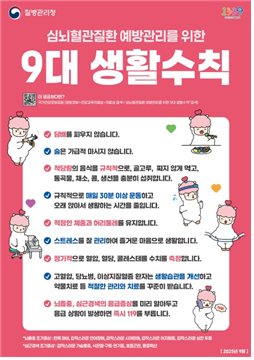
이 이미지는 심뇌혈관질환 예방관리를 위한 9대 생활수칙을 그림과 함께 안내하고 있다.
- 담배를 피우지 않습니다.
- 술은 가급적 마시지 않습니다.
- 적당량의 음식을 규칙적으로 섭취합니다. (골고루, 짜지 않게 먹고, 통곡물·채소·콩·생선을 충분히 포함)
- 규칙적으로 매일 30분 이상 운동하고 오래 앉아 있는 시간을 줄입니다.
- 적정한 체중과 허리둘레를 유지합니다.
- 스트레스를 잘 관리하며 즐거운 마음으로 생활합니다.
- 정기적으로 혈압, 혈당, 콜레스테롤 수치를 측정합니다.
- 고혈압·당뇨병·이상지질혈증 환자는 생활습관을 개선하고 필요할 경우 꾸준히 약물 치료를 받습니다.
- 뇌졸중·심근경색증의 응급증상을 미리 알고 응급 상황 시 즉시 119를 부릅니다.
의미: 생활습관 개선과 정기적인 건강 관리, 응급 상황 대처 능력을 통해 심뇌혈관질환을 효과적으로 예방·관리할 수 있음을 강조한다.
Content
- (Red Circle Campaign) For one month in September centered around the Cardiovascular and Cerebrovascular Disease Prevention and Management Week (September 1 – September 7), the Korea Disease Control and Prevention Agency and local governments jointly conduct the “Know Your Numbers, Red Circle Campaign.” What is the “Know Your Numbers, Red Circle Campaign?” This project intends to prevent cardiovascular and cerebrovascular diseases by helping people understand and manage their own blood pressure, blood sugar, and cholesterol levels.
- (Promotion of early recognition and response to severe/emergency conditions) Distribution of information on early symptom recognition and response measures for stroke and myocardial infarction.
- Early Symptoms of Stroke
- Sudden weakness in the face, arm, or leg on one side
- Sudden slurred speech or difficulty understanding others' speech
- Sudden loss of vision in one eye, loss of half of the visual field in both eyes, or double vision
- Sudden dizziness or difficulty maintaining balance
- Sudden severe headache unlike any experienced before
- Early Symptoms of Myocardial Infarction
- Sudden severe pain, pressure, or a crushing sensation in the chest
- Sudden severe pain or discomfort in the jaw, neck, or back
- Sudden severe shortness of breath
- Sudden pain or discomfort in the arm or shoulder
- How to Respond When Early Symptoms Occur
- Call 119 for help without delay.
- Go to a hospital capable of providing acute care.
- It is dangerous for the patient to drive.
- Do not wait for family to arrive.
- Do not think the symptoms will just go away.
- Do not wait for an outpatient visit, even if it is night or the weekend.
- Early Symptoms of Stroke