HIV (Human Immunodeficiency Virus)
An abbreviation of “Human Immunodeficiency Virus,” HIV is the pathogen that causes acquired immunodeficiency syndrome.
HIV exists in all bodily fluids of an infected person, with particularly high concentrations found in blood, semen, vaginal secretions, and breast milk.
AIDS (Acquired Immune Deficiency Syndrome)
AIDS is an abbreviation of “Acquired Immune Deficiency Syndrome,” and its Korean name is "후천성면역결핍증." “Acquired” is a term that contrasts with “congenital,” meaning it is not hereditary, and “immune deficiency syndrome” refers to a condition in which immune cells responsible for the body’s defense functions are destroyed, leading to a diminished immune function.
HIV-infected Person
A general term referring to a person infected with HIV, that is, someone who carries HIV in their body.
AIDS Patient
This refers to a person who has been diagnosed with AIDS based on the presence of specific opportunistic infections that occur when HIV invades the body, destroys immune cells, and weakens immune function.
The criteria for diagnosing an AIDS patient is when the number of immune cells (CD4+ T cells) in the infected person is below 200 cells/㎣ or when opportunistic infections corresponding to "AIDS-defining illnesses" such as Pneumocystis pneumonia occur.
Clinical Latency Period
The clinical latency period refers to the time it takes from infection to the onset of disease, specifically the duration until symptoms appear after HIV has invaded the body.
The clinical latency period varies from person to person, and is generally known to be as short as 6 months to as long as over 15 years. In other words, it is influenced by the individual’s constitution, nutritional status, and the nature of the virus, so even after infection, there are many cases where no significant symptoms appear for over 10 years.
Course of HIV Infection
The clinical course of HIV infection progresses gradually, and the changes in the number of immune cells and the concentration of the virus in the blood over time after infection are illustrated in the figure below.
The course of HIV infection goes through three stages: acute symptoms, clinical asymptomatic phase, and symptomatic phase.
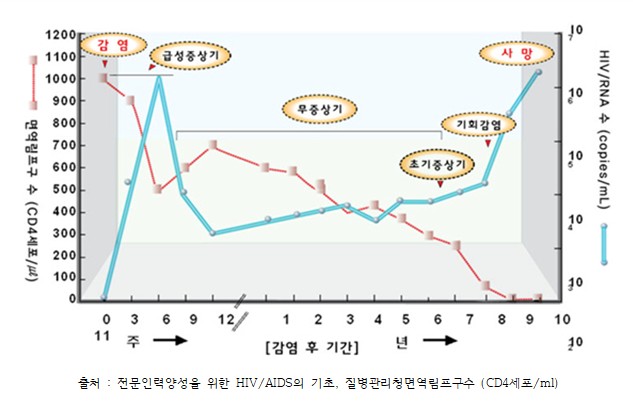
이 그래프는 HIV 감염 후 시간에 따른 면역세포 수(CD4 세포, 왼쪽 y축)와 혈액 내 HIV RNA 농도(바이러스 농도, 오른쪽 y축)의 변화를 보여준다. - 감염 직후: HIV RNA 수치가 급격히 증가하여 바이러스 농도가 매우 높아진다. - 급성증상기: 감염 후 수 주 내에 바이러스가 급증하고 면역세포 수가 급격히 감소한다. 이 시기에 발열, 림프절 종대 등 초기 증상이 나타날 수 있다. - 무증상기: 이후 면역계가 일시적으로 바이러스를 억제하면서 HIV RNA 농도가 다소 감소하고 일정 수준에서 유지된다. 그러나 면역세포 수(CD4)는 서서히 줄어들어 장기간 무증상 상태가 이어진다. - 기회감염기 및 증상기: 면역세포 수가 200/㎣ 이하로 크게 감소하면 폐렴, 결핵, 칸디다증 같은 기회감염이 나타난다. - 말기(사망 단계): 면역세포 수가 극도로 낮아지고 바이러스 농도가 다시 상승하며, 치료하지 않을 경우 사망에 이르게 된다. 즉, HIV 감염은 감염 직후 급성 증상기를 거친 뒤, 긴 무증상기를 지나 결국 면역저하로 인해 기회감염과 증상 발현기로 이어지는 3단계 경과를 보인다.
Acute symptom phase (3 to 4 weeks after infection)
30-50% of infected patients exhibit nonspecific symptoms such as fever, muscle pain, loss of appetite, nausea, abdominal pain, and skin rashes. Symptoms generally appear about one month after infection and last for approximately 10 to 15 days.
Clinical asymptomatic phase (before the onset of AIDS after infection)
After the symptoms of the acute infection phase subside, individuals can typically lead a normal life without specific symptoms for an average of about 8 to 10 years. The duration of this period varies among individuals; however, there is still a risk of transmission to others even in the absence of symptoms.
Symptomatic phase
After the asymptomatic phase, the early symptom phase presents several prodromal symptoms (such as weight loss, fatigue, loss of appetite, and insomnia). Subsequently, a late symptomatic phase occurs, where opportunistic infections or malignancies appear depending on the number of immune cells (CD4+ T cells).
Treatment for Infected Person
HIV treatment involves antiretroviral therapy (ART), which effectively reduces the amount of HIV in the body, helping to maintain the health of the infected person and prevent transmission to others. Although there is currently no cure, most individuals can achieve viral control within six months by adhering to prescribed medications through treatment.
The Joint United Nations Programme on HIV/AIDS (UNAIDS) has declared that individuals with HIV who take their medications properly and have an undetectable viral load do not transmit the virus through sexual contact (U=U; Undetectable = Untransmittable). This declaration has been adopted by all countries, including the United States and the United Kingdom.